


CREW Charlotte’s February 2024 Luncheon: “What’s Next at CLT?”
Submitted by Julie Pruett, Marlboro Development Team
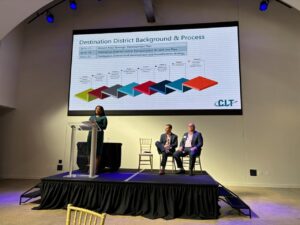
A record-breaking 245 people attended CREW Charlotte’s February Luncheon! Located 6 miles from the city center, Charlotte Douglas International Airport (CLT) stands as the seventh busiest airport in the United States, boasting a remarkable achievement in 2023 by accommodating over 53 million passengers, marking it as a record-breaking year. Ted Kaplan, Chief Business and Innovation Officer at CLT, elaborated on the airport’s economic significance. With 180 nonstop destinations and 36 international destinations, CLT generates $32 billion annually in economic impact in North Carolina, constituting 5% of the State’s GDP. Owned and operated by the City of Charlotte, CLT operates under a self-sustaining federal mandate, necessitating that all expenditures at the airport be covered by aeronautical and non-aeronautical revenues.
Stuart Hair, Director of Commercial and Community Engagement, outlined CLT’s response to its exponential growth through various airport renovations and expansions. The completion of the terminal lobby expansion, representing a $608 million investment, is anticipated by 2025. Concurrently, the ongoing Concourse A Expansion – Phase II, set to add 10 new gates, is slated for completion in 2024. Furthermore, the construction of a fourth parallel runway, earmarked for completion in 2027, symbolizes a monumental investment of $1 billion.
In tandem with aeronautical advancements, Jennifer Thompson, Commercial Engagement Manager, unveiled CLT’s endeavor to diversify revenue streams by releasing a Request for Proposal (RFP) for the development of a destination district. The RFP, aimed at generating non-aeronautical revenue, sets the deadline for proposals as February 22, 2024, with the selection of a developer scheduled for April 2024.
Charlotte Douglas International Airport (CLT) exemplifies not only a vital transportation hub but also a cornerstone of economic activity in North Carolina. With its ambitious expansion plans and strategic initiatives to bolster revenue, CLT is poised to continue its trajectory of growth and serve as a catalyst for economic development in the region.
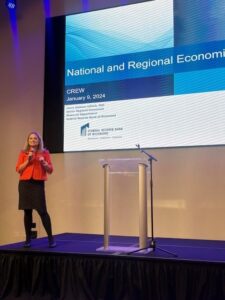 At the January luncheon, economist Laura Ulrich, with the Federal Reserve Bank of Richmond, delivered an optimistic message, assuring that the current data does not indicate a potential recession in 2024. Despite potential roadblocks, the resilience of consumer spending amid inflation stands out as a key factor in averting an economic downturn. Ullrich noted that the Federal Reserve has concluded its rate increases, and there are signs of rates starting to decline. Global supply chain issues have largely subsided to levels below those seen before the COVID-19 pandemic, although some isolated challenges persist. Housing starts and permits have seen an uptick in recent months, although they remain below 2021 levels, and the pervasive issue of housing shortages persists across communities. Notably, North Carolina emerges as a strong performer in employment recovery, with Raleigh, Durham, and Charlotte leading the way in exceeding the state’s 7 percent job growth. Despite the positive outlook, the tight labor market is acknowledged, and there is a recognition that it may continue to tighten in the future.
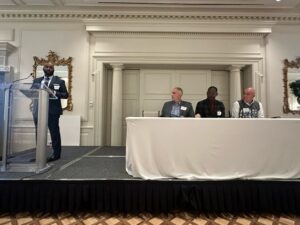 The final CREW luncheon of 2023 emerged as the pinnacle of inspiration and upliftment for the year. Guided by Antoine Dennard, a Partner at Quore Advisors, the event featured a captivating panel discussion which included his partner is in the Brookhill Village redevelopment, Mike Griffin with Griffin Brothers, Colin Pinkney with
  The Crescent Communities River District team, consisting of Fran West, Jennifer Sharraba, Lisa Phocas, and partner Bart Landess of Catawba Lands Conservancy, captivated a full audience with an update on their ambitious project, The River District. Departing from the conventional suburban model, this visionary 1,400-acre sustainable community seamlessly blends urban elements like homes, retail, dining, offices, and educational facilities with the enchantment of parks, trails, woodlands, and the Catawba River.
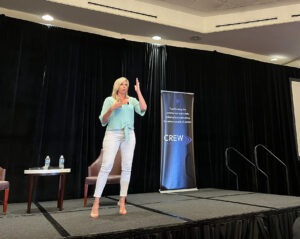 CREW Charlotte’s Signature Luncheon featured Sarah Thomas who changed the game in the world’s most quintessential male-dominated sport—football—by becoming the first female NFL official. Today, Sarah Thomas’s hat, whistle, and flag are on display at the NFL Hall of Fame and serve as a testament to this historic achievement.
 On Tuesday, April 14, Allison Kirby, Associate Director of Environmental, Social, and Governance (ESG) & Sustainability with Cushman & Wakefield’s Energy & Sustainability Asset Services presented to our membership on this city government-led development standard for commercial real estate funding. She spoke of the goals of the ESG standards, its evolving levels of compliance, and the challenges attached to each level. Also, the Inflation Reduction Act, recently passed by Congress, incentivizes developers to comply with ESG goals. Though different from LEED (Leadership in Environmental and Energy Design), the ESG standards complement LEED design and intent. Allison stated the markets she sees evolving are Multifamily, Class A office, and development in cities where local government has passed ESG initiatives.